empathy map
Market Your Product

5 Simple Market Research Tips to Understand What Your Customer Wants

Here are a few things I’ve learned about market research, the customer avatar, and customer language from working with so many experts in the field.

Over the last 10 years, I've gathered ‘avatar' and ‘market research' methods and strategies from Ryan Levesque, to Eben Pagan to Rich Schefren and many more in between…

Here's a Quick Market Research Checklist

1. Understand the problem you are actually solving first.

In other words, what is the MAIN desire of the market?

If you are in the weight loss industry, what do you help someone do?

You don’t help someone “lose weight”.

You might;  help women lose 50 pounds of belly fat after having a baby.

That’s the precise information you need first to do proper market research on your customer.

Every time I’m helping clients with their marketing…I get them to tell me the specific details. This will speed up your market research 10x because you know what to type into Google to start researching.

“how to lose baby fat” is more potent than “how to lose weight”

2. When you ask people about their frustrations, you can then be VERY specific.

Such as; “What frustrates you the most about trying to lose the extra baby fat?”

Talk about an emotional question.

Imagine what you get back from the market research audience.


3. Ask what they’ve ALREADY TRIED.

This is where you will get a LOT of gold that come in the form of objections to anything ‘new’, frustrations, emotions and so on.

You want to know what ANGERS them. Because this will help you write copy that converts.

Knowing this information also gives you insight on How to Write Headlines So You Can Position Your Product Better

Bottom line; if you help them throw rocks at their enemies (the stuff that didn’t work), you become a trusted advisor.


4. Ask what THEY think the solution is.

In this market research question, you will most likely get irrational answers. And that’s what you want. You want to know the irrational side to their thinking.

Because the irrational language is what they’re searching for;

“I want to lose 50 pounds of baby fat by the end of the month so I can get back into my bikini before I go on vacation”

The key here, is not to state something false…but to ENCOURAGE their dream…be the understanding person. Again, if you know what their irrational expectations are, you can speak to that in your copy/advertising.

For Example – Imagine If I Said;

“we know that most people who start online businesses want to become rich in 30 days and quit their job. If you’re here reading/watching this now, you already know that’s a stretch for most of us. We understand it takes a bit more work and time to get an online business to the point of replacing our job. The good news is, it doesn’t need to be a struggle. We don’t need to figure things out on our own. There are frameworks and strategies that when applied, are proven to speed up the process and eliminate the overwhelm…”

In this example, if I was selling a coaching program or a marketing thingy…I have empathy for the person, I’m pointing out their irrational thought (they might still have) and then bringing them into reality to encourage they can STILL have what they want (quit their job)
BTW, I DO offer a coaching program if you're interested in growing your business.  Click here to learn more about it.

ANYHOO…

Here's A Bonus Market Research Tip

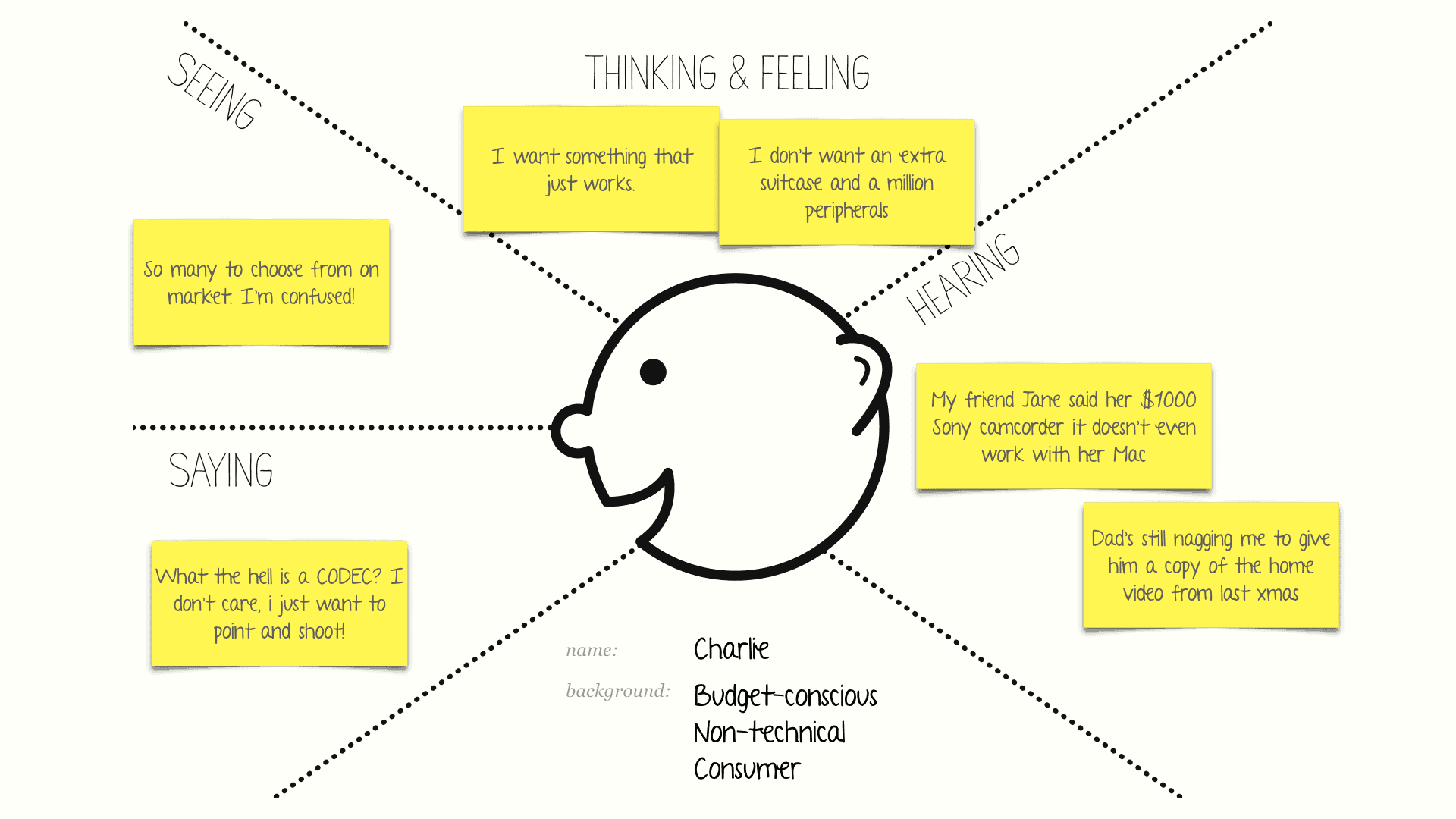
5. Use the empathy map to help you understand what to look for in the language of the customer.

Just google “empathy map”.  Download the worksheet.

You will ‘step into’ your customer’s head this way.

Here's a youtube video explaining the empathy map – I dunno this woman…but I like the name of her avatar 😉


 

Hope this helps you – any questions, jot ‘em below and I’ll do my best to answer.

Read More
copy that sells
Write Copy That Sells

the foolproof method to writing copy that sells

Writing copy that sells is not as difficult as it might seem.

Here's why.

One of my students told me he’s not sold anything yet.

Even though he’s been at it for quite a bit of time.

But somethin’s not connecting with his audience.

So, I asked him about his avatar.

He had the basic answers…

…but when we dug a bit deeper, he said “holy crap, nobody’s EVER asked me this about my avatar.”

The biggest frustration I see from clients is when they can't communicates with their market.

Which means the words they use in their marketing is either helping or HURTING them.

There’s no middle ground.

Think about that.

To me, learning my customers’ language, the way they speak and phrase things…

…it the MOST important piece of marketing and writing copy that sells.

We can be the best copywriter.

Our landing page might look awesome.

But if the words on the page aren’t saying the right thing…

…it’s all waste of time and money.


Grab my best copywriting tips here


So, let’s look at writing copy that sells from my student’s situation.

The biggest problem he’s having is trying to sell his product.

Thing is…

people aren’t SOLD products and services…they BUY them.

Read that again.

Whenever we want ‘sell’ our products, we need to position as a solution.

People look for solutions.

They don’t look for products.

Even more important, people look for solutions to URGENT problems.

Not something they can “hold off until next year.”

Like Perry Marshall says “look for the bleeding neck”

So what does this have to do with writing copy and communicating with your market?

EVERYTHING.

Because if you know what to look for, your copy “writes itself”

Take a look at these:


“I feel like my pride has taken a dent”

“I’m paralyzed by not knowing what to offer”

“I’m desperate – in debt, kids in college…if only belief could pay my bills”


I pulled these from my personal research of customer problems.

Do you hear any mention of a PRODUCT in those statements?

Nada.

If I want to know how to write good copy, I would use those phrases.

Imagine if I wrote this on a sales page for a program:


“…and after all the failures, we found that a lot of people felt like their pride has taken a dent.

They’re paralyzed by not knowing what to offer.

Some are in a desperate situation. They are in debt, have kids in college and so on.

If only belief could pay the bills.

But it won’t. Belief will keep us going…but we need a system that works.

Like NOW.

That’s why I created…”


Can you see how I took the simple language of the customer from before and “created” a sales pitch from it?

THAT’S how powerful this stuff is.

You can do this too.

I’m no professional copywriter.

But my audience is 🙂

So is yours.

Go where your audience hangs out and start ‘listening' to what they're saying and how they're saying it.

Then you'll know how to write good copy.


If you liked this – here's a short video on Writing Copy That Converts

Read More
write copy that sells
Write Copy That Sells

Use this ONE Rule to Write Copy That Sells

Do you want to write copy that sells?

Here’s ONE rule to follow:

“make it all about the prospect”

If we don’t focus on the prospect and what they want, we’ll have a very difficult time convincing them to buy anything.

I know you “know” this.

The question is, are you PRACTICING this rule?

Here’s why I’m asking.

Both of us see a lot of marketing and advertising that builds the company (and/or person) up.

Not the prospect.

The company tells us how great and successful they are. And then pivot to sell us their product so we can be the same thing.

They focus on the list of stuff we get.

They tell us how much everything is worth – that it’s a great deal.

BTW, I’m not saying to ignore that stuff, because everything has a place.

But most of the marketing we see STOPS there.

Too many marketers forget about the rule to write copy that sells; “make it about the prospect”.

“Appeal to the reason, by all means. Give people a logical excuse for buying that they can tell to their friends and use to save their own consciences. But if you want to sell goods, if you want action of any kinds, base your real urge upon some primary emotion!” — Robert Collier

Even if you have a physical product like a blender or something, it’s important to focus on the prospect.

Not the torque ratio of the blender and how it now comes in 8 different colours.

So, how do you make sure you follow this ONE rule?

The first thing is, you need to be completely in love with what you’re selling.

If you’re not 100% behind the product, why are you selling it?

Simple enough.

Don’t sell something for the sake of selling something.

Are you still with me?

Good.


Now that we know you love what you’re selling, DON’T try and sell it to a “crowd”.

What this means is to write copy that sells, write to one person.

Think of it as writing a personal letter to someone.

Because when a prospect is reading your copy, they’re reading it alone.

For example,

How do you feel reading this; “when entrepreneurs get this program, it changes their business in as little as 30 days”

Not bad.

But what about this?

“When you get this program, it will change your business in as little as 30 days”

Better. Don’t you think?

That’s because it’s talking directly to YOU.

Onward.

Last point – and then I’ll wrap up.


Be very clear about what your product (or service) will do for your customers.

Again – I know I’m preaching to the choir. But I see so many entrepreneurs missing this critical piece when they try to write copy that sells.

For the most part, it’s not our fault.

Why?

Because we’re too close to our product.

We forget about the simple, standard things that are obvious to us, but not to our prospects.

So, the solution is to step back and pretend to be your customer.

What would you need to know and feel about the product so you are ready to buy?

This is the reason I suggest all my clients and students NEVER stop “researching” and talking to the market.

Because once we are experts, we forget what it’s like to be a beginner.

It's very hard for us to unlearn.


Many times we talk to our market as if they’ve been through the same journey as we have.

We assume they’ve read the same books, know the same basics, and so on.

That’s simply not true.

They might be on the same PATH…but if we are the experts, it’s because we’ve experienced a bit more than they have.

And the reason we are selling whatever it is we are selling, is BECAUSE of that experience.

And the key to selling it, is to put your “beginner” shoes back on and speak to your prospect on that level.

Robert Collier brilliantly said:

“enter the conversation that’s going on in your prospects mind”.

So there you go.


In summary;

Make it ALL about your prospect.

Here’s how:

  1. LOVE what you are selling. Don’t sell something for the sake of selling and making money. Sell it because you know it will benefit your customers. It will make their lives better and more enjoyable.
  2. Talk to ONE person. In every piece of marketing communication you use. “How are YOU” not “How’s EVERYONE?”
  3. Step into their shoes. Go back to what it was like when YOU were in their shoes. talk to your customers from THAT place. Explain why your product is the best thing for them. Not by selling the fancy motor, but selling the way the car makes them feel when they drive out of their garage.

Hope this helps!

Do you want a Cheat Sheet to help with your copywriting?

Use these proven headline frameworks and bullet formulas to write compelling, effective copy in emails, ads and even sales pages…

>> Click Here to Get Your Cheat Sheet Right Now <<

Read More
writing copy
Write Copy That Sells

The Simple Way for Writing Copy That Works

Are you using penny or dollar words when you're writing copy?

Here’s why I’m asking.

You might be wasting space using “1-cent” words.

1-cent words are fillers.

In most cases, when I’m doing an audit on client’s, the filler words are usually buried in run-on sentences.

So, here’s what I suggest to every client writing copy;

“Get to the point”

In a minute, I’ll give you a few examples of how to edit when you're writing copy to make it flow.

But I want to make sure we’re on the same page.

“Get to the point” simply means “use all the words you need to get the point across – no more – no less”

I stole that from Einstein’s simplicity quote:

“everything should be made as simple as possible, but not simpler.”

So when you are writing copy, the simpler and to-the-point the better.

THAT’S why YOU can write great copy – even if you don’t think you can.

All you need is a simple framework. (no time for that here – let me stick to the point )

Onward.

In the following examples (taken from a client’s email sequence) I’ll show you examples of filler words.

Then I’ll show you how I changed them and why.

I won’t use the entire paragraph for privacy reasons. But what you see here should be plenty to get the gist.

Let’s go:

“Earlier today I was reflecting back on a conversation…”

Here’s the edit:

“Earlier today I reflected back on a conversation…”

Can you see the difference?

Even though NOTHING is wrong with the first rendition, the second one gets right to the point.

Let’s check out another one.

‘….each time they went to the gas station it was between $30-45….”

edit:

‘….each time they went to the gas station they spend between $30-45….”

Here’s why this subtle change is made.

when my client uses words like “it was” from the first example,  SHE knows she’s talking about money.

But the reader may not. They may lose the connection from the previous paragraph. (Trust me on this – because I’m not giving you the entire email)

The second reason I changed it is because “they spend” is more direct and it’s a VISUAL statement.  In writing copy, if you can make people ‘see' what you're describing, all the better!


BTW, here's one of the copywriting cheatsheets I use


Now.

Before we move on, I don’t want to freak you out. If you’re reading some of this thinking “See? I write like this too and that’s why I don’t like writing copy.”

Step back. Breathe.

Think about what my client did here.

She did the HARDEST part – which really isn’t hard at all.

Because she wrote the email like she talks.

Just like we’re told to do – am I right? -)

And that's AWESOME!

So, all I’M doing, is coming in with fresh eyes and cleaning things up for her.

Which means YOU can do the same thing.

Even if you don’t have a coach or someone you trust who knows what they're doing when it comes to writing copy.

Take what I’m saying here and you’ll learn how to edit your own in no time.

When you DO edit on your own;

  1. always step away from the copy for at least 24 hours.
  2. come back with fresh eyes and READ IT OUT LOUD
  3. edit/delete what no longer flows.

OK.

I’ll give you one last example so this sinks in.

The original:

“…I want to help her, guide her, and walk thru this process with her…”

Here’s my edit:

“…I want to help and guide her by walking thru this process together…”

In the first one, there’s too many “hers”.

Can you see that?

And, check out how we swapped out the last “her” and added “together”.

“Together” is a POWERFUL $100 word when you're writing copy 🙂

Read that last edit again and tell me if you don’t feel the emotion to get started.

Because if you need help, guidance and don’t want to be alone, that sentence says it all –

It says it in a shorter way – and…

to

the

point-)

BTW – my clients make this stuff easier for me.

They start the ball rolling. Without their input and initial thoughts, I would be lost :-).

My intention showing you this is not to throw anyone under the bus. It’s about learning from each other.

Hope this helps you too!

Do you want a Cheat Sheet to help with your copywriting?

Use these proven headline frameworks and bullet formulas to write compelling, effective copy in emails, ads and even sales pages…

>> Click Here to Get the Cheatsheet Now <<

Read More
email marketing platform
Improve Email Marketing

Which email marketing platform is best for tagging and automation?

Got this question asked: Which email marketing platform has the best options for tagging and automation?

Here's my answer:

Depending on what you want to accomplish. “tagging” is the beginning of automation.

Because “tagging” means more than just putting people onto a ‘list.’

I work with many clients and have access to almost every email marketing platform out there.

There are pros and cons to every email marketing platform.

Of course, you know that.

So, to begin, I use Infusionsoft.

I know a lot of people will say they are “not ready” for Infusionsoft…but my job as a coach and consultant is to challenge them on where they want to

GO … not where they are now.

disclaimer – I’m NOT trying to sell you on Infusionsoft or any other…I’m just beginning the conversation with why I use it so you can get your mindset around your business needs and not the actual platform.

Onward.

Back to my clients – MOST of them want their email marketing platform to handle automation based on specific behaviour. In other words, behaviour that goes well beyond “if-then’that” automation.

That’s why Infusionsoft is a huge leader here.

Whenever you think you are not ‘ready’ for the bigger investment…ask yourself why not?

From my experience, we are building a business to get more FREEDOM – and automation does that.

So if you choose the cheaper route today, it will cost you more freedom and money in the future. it will CERTAINLY cost you more money (because you might be a bagillionaire to hire someone to move your list to another platform )

But “moving” the list and paying someone is NOT the issue.It’s that you’ll lose people in the transition.

So, let’s go back to what you want to do with tagging and automation when it comes to your email marketing platform.

Here’s an example:

email marketing platform

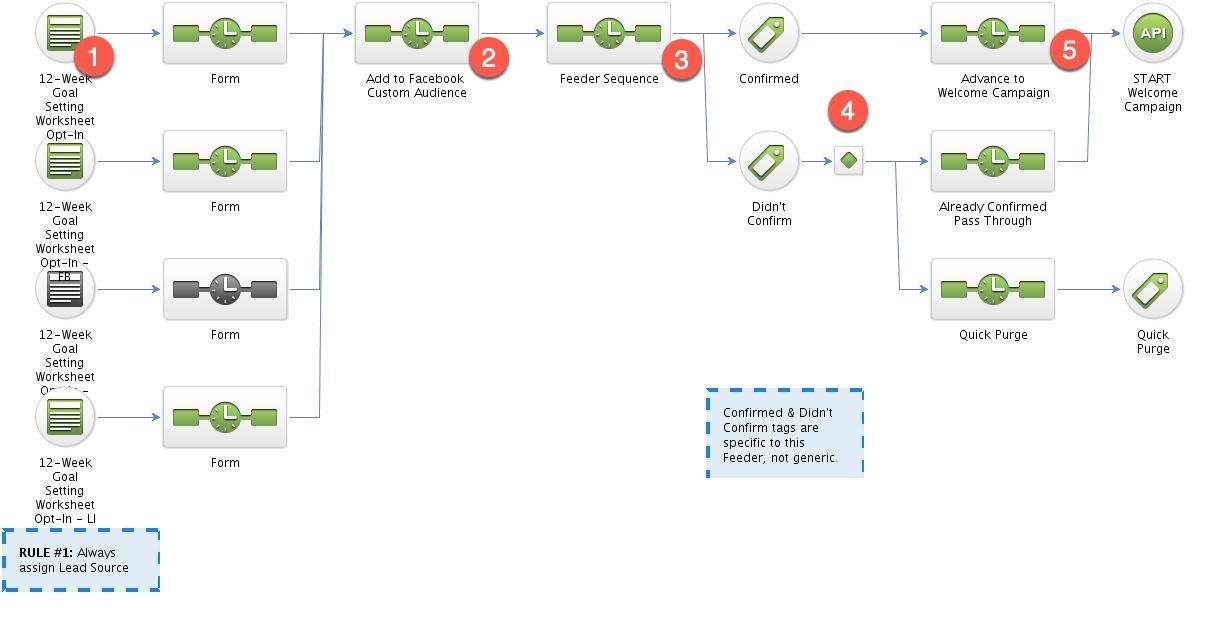
As you can see from the pic above, I have a simple ‘opt-in’ ‘campaign/automation’ for each lead magnet.

Here's what happens.


1. They opt in (using specific forms from specific traffic)

2. They are added to Facebook custom audience (so I can retarget, or eliminate from ads for this lead magnet, etc)

3. They are sent the lead magnet – (this process is to get a confirmed email – you will notice there are two tags – confirmed / didn’t confirm)

4. The automation looks to see whether they confirmed or didn’t. THEN it does one of two things. It allows them to pass through, because they’ve already confirmed before/somewhere else…or, they are purged from the list.

This purge is MY personal choice. It’s what keeps my list highly engaged, and I have an 100% confirmed list – which makes deliverability and all that 10x better. But that’s for another discussion.

5. Last step is they are advanced to my main welcome campaign. EVERYONE goes into that welcome campaign – regardless of how many times they opt-in, if they’re confirmed, whatever…


And THIS is where the automation goes even further…it’s also the reason Infusionsoft for me is one of the best when deciding on an email marketing platform.

It's highly effective when it comes to nailing behavioural marketing…which all comes back to tags 🙂


Related:

The Quickest and Easiest Way to Build Marketing Automation


Anyhoo, everyone will have their reasons for what they use.

I’m partial to Infusion because it’s what I use.But I have many clients who don’t.

They use Kajabi – which is a GREAT email marketing platform! And, it happens to have a product and membership platform as well :-). It's what I use for my membership and products.


The advice I would give you, is to analyse first what you need the automation and tagging to do.

If you don’t really know, then set up a call with me so we flush out the proper blueprint so you can decide fairly and avoid any problems in the future having to move stuff around and rebuild:

Blueprint Session Invite

Read More