best lead magnets
Write Copy That Sells

Are the best lead magnets positive or negative focused?

Michelle asks this about the best lead magnets:

“I appreciate we all have very different avatars. But wondered what the actual experience has been with lead magnets in terms of being negative or positive?

Humans are twice as motivated to avoid loss over gain, so wondering if “3 ways to avoid xyz mistakes is stronger than 3 ways to achieve xyz.

I will be testing this but would love to hear your experiences”

the simple answer is this:

It’s 10x more difficult to sell prevention

Which is why insurance people have a hard time.

The reason is,  if we’re trying to create the best lead magnets and sell a situation that may or may not happen in the future,  we need to change the worldview of our customers.   (related: How to Persuade People and Influence Them To Buy)

It’s hard.

I’m not saying it can’t be done…

…but imagine selling headache medicine to someone who doesn’t have a headache ‘yet’.

“Buy these now in case of headache”

They’re thinking; “yea…if I have some time, maybe I’ll swing by the store and grab a bottle.”

Know what I mean?

There’s no urgency.

Above all, there’s no ‘bleeding neck’

That’s why the best lead magnets are when we ‘step into the world’ of our prospect and highlight the crisis.

It allows you to write better copy that gets noticed

Because your customers are actively looking for a solution to stop the pain – whatever that pain is.

Finally;

You don’t need to choose one over the other. You can combine a negative and positive message to create your best lead magnets:

“How to avoid X and get/feel Y”

Cool, right?

We love working on best lead magnets and more, every 2 weeks live on our Strategic Profit Lab coaching calls.

Strategic Profit Lab is right for you if you don’t want to spend more money on programs, products or courses, searching all alone to find the right answers.

Instead, you get the right formulas and methods that adapt to and fit your business perfectly. Because I help you find the right pieces and then put them together.

Here’s where you can join the tribe: Strategic Profit Lab

Read More
copy that sells
Write Copy That Sells

the foolproof method to writing copy that sells

Writing copy that sells is not as difficult as it might seem.

Here’s why.

One of my students told me he’s not sold anything yet.

Even though he’s been at it for quite a bit of time.

But somethin’s not connecting with his audience.

So, I asked him about his avatar.

He had the basic answers…

…but when we dug a bit deeper, he said “holy crap, nobody’s EVER asked me this about my avatar.”

The biggest frustration I see from clients is when they can’t communicates with their market.

Which means the words they use in their marketing is either helping or HURTING them.

There’s no middle ground.

Think about that.

To me, learning my customers’ language, the way they speak and phrase things…

…it the MOST important piece of marketing and writing copy that sells.

We can be the best copywriter.

Our landing page might look awesome.

But if the words on the page aren’t saying the right thing…

…it’s all waste of time and money.


Grab my best copywriting tips here


So, let’s look at writing copy that sells from my student’s situation.

The biggest problem he’s having is trying to sell his product.

Thing is…

people aren’t SOLD products and services…they BUY them.

Read that again.

Whenever we want ‘sell’ our products, we need to position as a solution.

People look for solutions.

They don’t look for products.

Even more important, people look for solutions to URGENT problems.

Not something they can “hold off until next year.”

Like Perry Marshall says “look for the bleeding neck”

So what does this have to do with writing copy and communicating with your market?

EVERYTHING.

Because if you know what to look for, your copy “writes itself”

Take a look at these:


“I feel like my pride has taken a dent”

“I’m paralyzed by not knowing what to offer”

“I’m desperate – in debt, kids in college…if only belief could pay my bills”


I pulled these from my personal research of customer problems.

Do you hear any mention of a PRODUCT in those statements?

Nada.

If I want to know how to write good copy, I would use those phrases.

Imagine if I wrote this on a sales page for a program:


“…and after all the failures, we found that a lot of people felt like their pride has taken a dent.

They’re paralyzed by not knowing what to offer.

Some are in a desperate situation. They are in debt, have kids in college and so on.

If only belief could pay the bills.

But it won’t. Belief will keep us going…but we need a system that works.

Like NOW.

That’s why I created…”


Can you see how I took the simple language of the customer from before and “created” a sales pitch from it?

THAT’S how powerful this stuff is.

You can do this too.

I’m no professional copywriter.

But my audience is 🙂

So is yours.

Go where your audience hangs out and start ‘listening’ to what they’re saying and how they’re saying it.

Then you’ll know how to write good copy.


If you liked this – here’s a short video on Writing Copy That Converts

Read More
write copy that sells
Write Copy That Sells

Use this ONE Rule to Write Copy That Sells

Do you want to write copy that sells?

Here’s ONE rule to follow:

“make it all about the prospect”

If we don’t focus on the prospect and what they want, we’ll have a very difficult time convincing them to buy anything.

I know you “know” this.

The question is, are you PRACTICING this rule?

Here’s why I’m asking.

Both of us see a lot of marketing and advertising that builds the company (and/or person) up.

Not the prospect.

The company tells us how great and successful they are. And then pivot to sell us their product so we can be the same thing.

They focus on the list of stuff we get.

They tell us how much everything is worth – that it’s a great deal.

BTW, I’m not saying to ignore that stuff, because everything has a place.

But most of the marketing we see STOPS there.

Too many marketers forget about the rule to write copy that sells; “make it about the prospect”.

“Appeal to the reason, by all means. Give people a logical excuse for buying that they can tell to their friends and use to save their own consciences. But if you want to sell goods, if you want action of any kinds, base your real urge upon some primary emotion!” — Robert Collier

Even if you have a physical product like a blender or something, it’s important to focus on the prospect.

Not the torque ratio of the blender and how it now comes in 8 different colours.

So, how do you make sure you follow this ONE rule?

The first thing is, you need to be completely in love with what you’re selling.

If you’re not 100% behind the product, why are you selling it?

Simple enough.

Don’t sell something for the sake of selling something.

Are you still with me?

Good.


Now that we know you love what you’re selling, DON’T try and sell it to a “crowd”.

What this means is to write copy that sells, write to one person.

Think of it as writing a personal letter to someone.

Because when a prospect is reading your copy, they’re reading it alone.

For example,

How do you feel reading this; “when entrepreneurs get this program, it changes their business in as little as 30 days”

Not bad.

But what about this?

“When you get this program, it will change your business in as little as 30 days”

Better. Don’t you think?

That’s because it’s talking directly to YOU.

Onward.

Last point – and then I’ll wrap up.


Be very clear about what your product (or service) will do for your customers.

Again – I know I’m preaching to the choir. But I see so many entrepreneurs missing this critical piece when they try to write copy that sells.

For the most part, it’s not our fault.

Why?

Because we’re too close to our product.

We forget about the simple, standard things that are obvious to us, but not to our prospects.

So, the solution is to step back and pretend to be your customer.

What would you need to know and feel about the product so you are ready to buy?

This is the reason I suggest all my clients and students NEVER stop “researching” and talking to the market.

Because once we are experts, we forget what it’s like to be a beginner.

It’s very hard for us to unlearn.


Many times we talk to our market as if they’ve been through the same journey as we have.

We assume they’ve read the same books, know the same basics, and so on.

That’s simply not true.

They might be on the same PATH…but if we are the experts, it’s because we’ve experienced a bit more than they have.

And the reason we are selling whatever it is we are selling, is BECAUSE of that experience.

And the key to selling it, is to put your “beginner” shoes back on and speak to your prospect on that level.

Robert Collier brilliantly said:

“enter the conversation that’s going on in your prospects mind”.

So there you go.


In summary;

Make it ALL about your prospect.

Here’s how:

  1. LOVE what you are selling. Don’t sell something for the sake of selling and making money. Sell it because you know it will benefit your customers. It will make their lives better and more enjoyable.
  2. Talk to ONE person. In every piece of marketing communication you use. “How are YOU” not “How’s EVERYONE?”
  3. Step into their shoes. Go back to what it was like when YOU were in their shoes. talk to your customers from THAT place. Explain why your product is the best thing for them. Not by selling the fancy motor, but selling the way the car makes them feel when they drive out of their garage.

Hope this helps!

Do you want a Cheat Sheet to help with your copywriting?

Use these proven headline frameworks and bullet formulas to write compelling, effective copy in emails, ads and even sales pages…

>> Click Here to Get Your Cheat Sheet Right Now <<

Read More
writing copy
Write Copy That Sells

The Simple Way for Writing Copy That Works

Are you using penny or dollar words when you’re writing copy?

Here’s why I’m asking.

You might be wasting space using “1-cent” words.

1-cent words are fillers.

In most cases, when I’m doing an audit on client’s, the filler words are usually buried in run-on sentences.

So, here’s what I suggest to every client writing copy;

“Get to the point”

In a minute, I’ll give you a few examples of how to edit when you’re writing copy to make it flow.

But I want to make sure we’re on the same page.

“Get to the point” simply means “use all the words you need to get the point across – no more – no less”

I stole that from Einstein’s simplicity quote:

“everything should be made as simple as possible, but not simpler.”

So when you are writing copy, the simpler and to-the-point the better.

THAT’S why YOU can write great copy – even if you don’t think you can.

All you need is a simple framework. (no time for that here – let me stick to the point )

Onward.

In the following examples (taken from a client’s email sequence) I’ll show you examples of filler words.

Then I’ll show you how I changed them and why.

I won’t use the entire paragraph for privacy reasons. But what you see here should be plenty to get the gist.

Let’s go:

“Earlier today I was reflecting back on a conversation…”

Here’s the edit:

“Earlier today I reflected back on a conversation…”

Can you see the difference?

Even though NOTHING is wrong with the first rendition, the second one gets right to the point.

Let’s check out another one.

‘….each time they went to the gas station it was between $30-45….”

edit:

‘….each time they went to the gas station they spend between $30-45….”

Here’s why this subtle change is made.

when my client uses words like “it was” from the first example,  SHE knows she’s talking about money.

But the reader may not. They may lose the connection from the previous paragraph. (Trust me on this – because I’m not giving you the entire email)

The second reason I changed it is because “they spend” is more direct and it’s a VISUAL statement.  In writing copy, if you can make people ‘see’ what you’re describing, all the better!


BTW, here’s one of the copywriting cheatsheets I use


Now.

Before we move on, I don’t want to freak you out. If you’re reading some of this thinking “See? I write like this too and that’s why I don’t like writing copy.”

Step back. Breathe.

Think about what my client did here.

She did the HARDEST part – which really isn’t hard at all.

Because she wrote the email like she talks.

Just like we’re told to do – am I right? -)

And that’s AWESOME!

So, all I’M doing, is coming in with fresh eyes and cleaning things up for her.

Which means YOU can do the same thing.

Even if you don’t have a coach or someone you trust who knows what they’re doing when it comes to writing copy.

Take what I’m saying here and you’ll learn how to edit your own in no time.

When you DO edit on your own;

  1. always step away from the copy for at least 24 hours.
  2. come back with fresh eyes and READ IT OUT LOUD
  3. edit/delete what no longer flows.

OK.

I’ll give you one last example so this sinks in.

The original:

“…I want to help her, guide her, and walk thru this process with her…”

Here’s my edit:

“…I want to help and guide her by walking thru this process together…”

In the first one, there’s too many “hers”.

Can you see that?

And, check out how we swapped out the last “her” and added “together”.

“Together” is a POWERFUL $100 word when you’re writing copy 🙂

Read that last edit again and tell me if you don’t feel the emotion to get started.

Because if you need help, guidance and don’t want to be alone, that sentence says it all –

It says it in a shorter way – and…

to

the

point-)

BTW – my clients make this stuff easier for me.

They start the ball rolling. Without their input and initial thoughts, I would be lost :-).

My intention showing you this is not to throw anyone under the bus. It’s about learning from each other.

Hope this helps you too!

Do you want a Cheat Sheet to help with your copywriting?

Use these proven headline frameworks and bullet formulas to write compelling, effective copy in emails, ads and even sales pages…

>> Click Here to Get the Cheatsheet Now <<

Read More
email marketing ideas
Email Copywriting

Email Campaign Case Study: How to Avoid These Mistakes

OK, this email campaign case study is gonna be a total RANT.

Because in this day and age of email marketing, there’s just NO EXCUSE.

If you’re a real estate agent, LISTEN CLOSELY.

If you’re not a real estate agent – LISTEN EVEN CLOSER –

Because you will learn how the real estate agent industry drops the ball in the marketing EVERY DAY.

To demonstrate this email campaign:

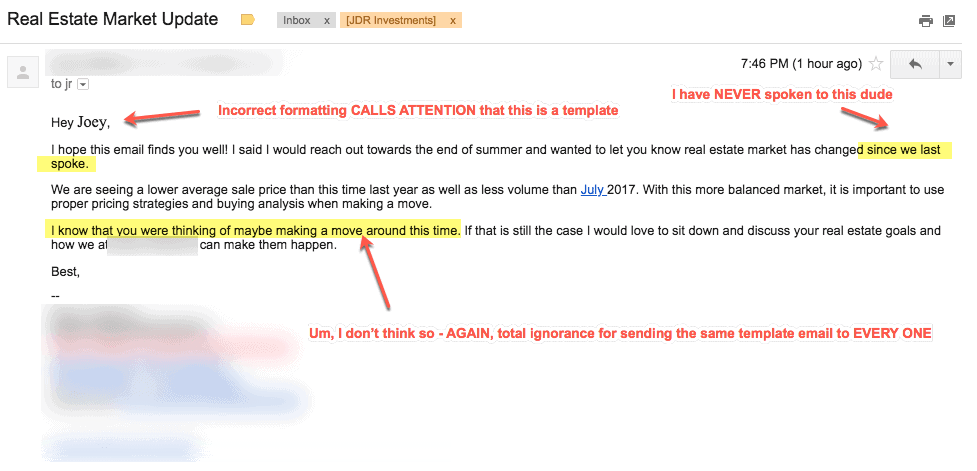
Let’s take a look at this email I received.

I’ll point out everything wrong so you can avoid this sh!t in your business.

email campaign

Even though I’m anal retentive and spot stuff like this more than most, the first thing you’ll notice is the formatting of my name.

It has a different font. Different size.

CLEARLY, it’s been inserted into a canned template this dude pulled from his brokerage.

Now.

If you’re thinking “what’s wrong with using templates?”

The answer is “nothing.”

IF YOU DO IT RIGHT.

The trouble is…this dude is NOT doing it right.

Here’s why:

Aside from my name clearly being inserted, the first line sucks – just my opinion.

Because “I hope this email finds you well” is so corporate.

How many times have you reached out to your friend and said: “I hope this text/email/phone call finds you well?”

Onward.

The rest of line one is where this email campaign turns from bad to worse…

…”since we last spoke.”

Um…I’ve NEVER spoken to this dude.

I’ve NEVER been a client.

I don’t even KNOW this dude.

So, if he’s bankin’ on the fact that I’m too busy to remember that sh!t, he’s wrong.

Therefore, this all too famous mistake totally screams “CANNED EMAIL CAMPAIGN TEMPLATE.”

Next, he goes on to tell me all about the market. He tells me I need to use proper pricing strategies and buying analysis.

No sh!t Sherlock.

I’m actually looking to use the WRONG pricing and buying analysis…because I like to roll the dice.

It’s like telling someone “it’s important to put on a parachute when you jump out of an airplane”

Sorry.

I told you this would be a total email campaign rant.


related:Is Your Email Campaign Marketing Scaring People Away?


Anyhoo,

Mr. lazy-ass realtor marketer totally screws himself to the wall by finishing with his last paragraph:

“I know that you were thinking of maybe making a move around this time…”

REALLY?

When did I say that?

Um…we have NOT ever considered “maybe” making a move around this time…

All this paragraph tells me, is he uses the bullsh*t ‘laws of average’ stuff real estate agent emails are famous for.

I’m sure you’ve seen similar emails.

So you might be thinking…

First, Joey’s a pretty harsh dude.

No argument.

But my direct approach works for my clients because they don’t go down these stupid rabbit holes.

Second, you might wonder how could this be a better email.

I’ve got your back.

Here’s how to use those email campaign templates (if you choose) from your brokerage.

Step one. SEGMENT your email list into buyers, sellers, prospects.

It’s that simple.

Perhaps spend a bit of time TAGGING me if we had a call or not, so you know what to say in your email.

That means 2 separate emails would be sent.

One to people who you actually spoke to (with the “since we spoke” line)…and one to people who you DIDN’T speak to (without the “since we spoke” line).

I’m not done.

What if the list was segmented even further?

Maybe you tag people you spoke to, AND said they might be thinking about moving LATER…

Easy, that’s a third segmented email with the last line inserted: “I know you were thinking of maybe making a move…”

Doing JUST that would align your emails with the right person.

This isn’t rocket science.

The reason I get so bent out of shape with this is that its pure laziness.

Thank GAWD my realtor clients listen to me and avoid all of these horrendous email campaign mistakes.

That’s it.

Rant over.

Read More