
core value list
Set Smart Goals and Growth Mindsets

Why Core Values Are Important to Your Online Business

Why core values are important

Most of us do not want the constant stress about making decisions.

In this post, we’ll discover the true values that will help us stop spinning our wheels when trying to make the right choices.

We’ll learn the key differences between our wants and needs and how core values influence decision-making.

You will know what core values are important so you can use them every day to make important decisions and live without anxiety.

Not only that, but core values for business make entrepreneurs like us feel happier.


Why Core Values Matter

As I mentioned, most people don’t want to worry about making decisions. Especially the WRONG decisions.

They want to enjoy their business, live without stress and anxiety, and do what they love to do.  

This makes them feel happier and more passionate about their life’s work.

By following this simple outline, you will no longer have regrets about decisions. Because you’ve been true to yourself and your core values.

You will have peace of mind knowing that your goals are in sync with everything that is important to you.

And, even more important, you have the optimal motivation to keep you on track instead of spinning your wheels.


The Difference between Needs, Wants, and Core Values

Needs: are things you must have in order to live, to be at your best.

Wants: are things that you are trying to get or experience

Core Values: you are naturally drawn to them from within. NOT by needs or wants.


Core values are important to you because they are part of your ‘inner animal’ – recognize that you have inside, billions of years of evolution that is beyond your comprehension and control

When you accept your ‘inner chimpanzee”, you no longer struggle with trying to sort everything out in your life intellectually

  • Because your inner chimp has urgent needs
  • When you crave something, it’s probably a want
  • If you find yourself naturally attracted to something, without being ‘pushed’ or ‘pulled’ to do it…

    …it is probably a core value to live by.


Read that last part again.


Characteristics of a NEED:

  • A need is something that gives you satisfaction 
  • It is required for you to function optimally, like money, food, exercise, tools, etc.
  • You generally feel an urgency to get a need met. 
  • If you have unmet needs, your judgment of values is clouded.


Characteristics of a WANT:

  • A want makes you feel gratification.
  • They are things you enjoy, want to gain, acquire & experience such as sex, promotions & awards, a new car, vacations, etc.
  • You’ll know by the amount of desire and craving if it’s a ‘want’
  • When you make decisions based on wants and needs, they are not likely to be beneficial on a continuous basis


Characteristics of a CORE VALUE:

    • Core values can be defined as your natural interests 
    • You feel incredible when you are doing anything related to your values
    • There is no need to ‘push’ you to do them


Action Steps: Identify your Core Values

  1. Make a core values list. Identify the values most important to you.
  2. After you’ve identified your core values, test them against areas in your life and business – maybe a project you’re working on, people in your life, environments you frequent. See if they align (or not) with your new core values discovery.
  3. When you find something out of line with your core values, do something about at LEAST one this week – improve it, delegate, or remove it completely from your life.

How will the core values help you holistically?

  • Core values drive you. They are a part of who you are. And when you know what your core values are, you make better, faster, and easier decisions.
  • You will be able to set better goals that keep you motivated
  • You stop spinning your wheels when you can’t decide on a course of action – because your core values give you an alternative perspective. You will find your core values choose for you.
  • You are able to identify why you’re ‘suddenly’ upset or feel weird because someone violates your core values
  • You can identify the difference between a want, need, and your true core values.
  • Make authentic choices and live without frustration and anxiety
  • You begin to let go of draining people, projects, and goals that don’t express your true values.
  • You begin to enjoy your work – every day.
  • You always know what the right answer is without having regret or worry


There you go!  

I hope this helps you align your core values with everything you do.

Let me know below if you have any questions, comments, or feedback 🙂

Read More
minimum viable product
Increase Your Sales

Sell Your Online Course with a Minimum Viable Product

Even before marketing…we need a minimum viable product.

Yes. Before “scale” and automation systems.

We need validation.

Stick with me.

You already know the importance of market research.

Finding a market with a problem. And then offer the solution.

But here’s what I’ve discovered after failing more often than I care to admit.

MANY times just “knowing” the market problem isn’t enough.

Here’s why;

Whenever I didn’t sell, it was because I created a product/service that nobody wanted.

Sure. Marketing language, campaign automation, email follow-up…it’s ALL important.

And if you know me, I’m ALL about marketing and niche language.

BUT THERE’S A STEP THAT COMES BEFORE ALL OF THAT.

Validate the demand for your online course with an MVP product:

1. be sure it is something your Dream Clients want – and by want, I mean they are willing to pay for it
2. it delivers the result you promise

Nothin’ groundbreaking there.

But trust me. A LOT of people skip this step.

The reason I skipped it is because I just wanted my product on the market – makin’ moola.

Big mistake.


Let’s jump back to the minimum viable product validation:

‘Cos I know some people think “I’ve done the validation part. I did a survey. Or looked at some forums to see that people have the problem”

Nothin’ wrong with that.

I encourage all of it.

But we still don’t know if people will buy what we have.

We don’t know if it gets a REPEATABLE result for anyone.

Enter the minimum viable product – or as I like to call it…the Beta Product.

The beta idea is nothing new.  People have done it since the dawn of ages.

But it’s critical.

Critical because it:

  1. proves people will pay for your solution (which means they want it)
  2. helps you tweak and improve your solution.
  3. gives you the missing pieces.

there’s more – but those are the main 3.

So, what’s the first step to validate?

My advice is to build your product WITH people.

One of the biggest mistakes is to:

“make a key and then go and try to find a lock to open” – Seth Godin


Let’s get you set up to offer a minimum viable product:

1. Create a landing page that talks about the problem and offers the solution.

you want people to opt-in.

you tell people this is a beta – and there is NO course/program built yet.

you CHARGE for this (I can’t stress this enough) – make sure everyone knows it’s not free. (validation point)

This step is important because you verify you have the problem and promise nailed.

BEFORE you create anything.

Guess what.

If NOBODY opts in, you haven’t nailed the problem/solution. AND/or your offer is something nobody wants.

If that sounds bad…it’s actually a GOOD thing.

Because you’ve just saved yourself MONTHS of work. And even MORE months of frustration trying to market something nobody will buy…causing you stress and anxiety – even wasting money trying to find ‘leads’.

(BTW, a better way to avoid chasing leads is to work only with Dream Clients)

Of course, this is not the only way to run a minimum viable product beta.

But from my experience, I am telling you that it’s the fastest and easiest.

Anyhoo…

I hope this helps you – if you have a question about the validation beta process ask me below. I’m obsessed with this process and love to share 🙂

BTW, if you are ready to launch a beta group program with Premium Dream Clients – even if you don’t have anything created yet – get PAID upfront – do 96% work than conventional launches without pressured, fear-based marketing email me with the word MINIMUM in the subject line and we’ll chat about how I can help you increase your revenue this year.
Read More
Market Your Product

3 questions you need to make selling easy

Here’s something you’ll find interesting…

Simple frameworks are always the ones that work.

Yet I still see people mucking everything up with complex funnels thinking the more moving pieces the better.

Listen up.

To create a product/program/widget that sells with ease, you begin with ONE thing and one thing only.

The RIGHT client.

Not ANY client.

The RIGHT one.

I know. ‘Tell me something I don’t know Joey.’

Well, here’s the funny thing…even though it’s a known fact that marketing and selling to Dream Clients is the EASIEST thing to do, you will find a billion people still trying to market to EVERYONE and ANYONE.

So let’s make selling easy on ourselves.

Here are the 3 areas you MUST have right if you want to get this selling thing down: 

  1. THE RIGHT PEOPLE
  2. THE RIGHT PROBLEM
  3. THE RIGHT PROMISE

It’s my 3P framework 🙂 

Talk about brilliant names LOL

If you think it’s nothing…think again.

When you nail these 3, you will have no problem marketing (and ultimately, selling) your product. AND get paid what you are worth.

And that’s pretty good, don’t you agree?

Let me break how to make selling easy down further by using these simple questions;

  • Who are the people (aka dream clients) you serve?
  • What is the urgent, pressing problem they must solve?
  • What promise do you make to deliver the solution to their problem?

Wow! A simple framework isn’t it?

:: smile :: 

I’m telling ya – get those right and Dream Clients won’t argue about the price.

And that’s just the beginning. You get dream clients chasing after YOU instead of the other way around.

Best of all, you drop the tire kickers.

How does that sound?

Go ahead and answer those 3 questions.

If you need more clarity, have a question or two about them, lemme know I’ll help ya out.

Joey “3-P” Ragona

Read More
WriteFast Copywriting Method
Write Copy That Sells

The WriteFast ™ Copywriting Process

Here is a summary of the proprietary WriteFast™ copywriting method I use when I write copy.

It will totally help you write fast and powerful copy that persuades and converts.  This method is called DynamicAssembly™. It’s the foundation of what I teach in my Write Marketing Copy program.

Think of this copywriting process as “Copy Lego”

1. Go to areas where your avatar hangs out (forums, FB groups, Amazon book reviews, Quora, even places like Udemy, etc) and copy everything where they talk about their problems, pains, frustrations, wants, needs, etc.  This is the way you do easy copywriting research.

copy and paste to ONE big doc.

I call this a Copybank™

(you can see a demonstration of the Copybank™ here)

One important rule: do NOT edit or decide at this point on “will I use this?” Or “how will I use this?”

Just swipe the market language. It’s one of the best copywriting research methods I know

2. Highlight and summarize the CopyBank™  document. Pick out the language patterns, emotional words etc.

3. USE those words and phrases to answer the Empathy Questions:

  • What do they see
  • What do they  hear
  • What do they  think
  • What do they say
  • What do they do
  • What do they feel
  • What are the pains
  • What are the gains?

BTW, it doesn’t matter where we use this language either. Landing page – sales page, email, challenge or chat copy…whatever.

  1. Then look for patterns. Because patterns group into objections. Turn the objections into positive statements. (This is specifically for sales pages etc. But still, work as individual emails) and prove the claim and give benefits.
    Use the words and phrases all the way through. You hardly ever  “Write” copy.  You assemble it.

When you are ready, you now move that language into a ‘copy structure’ (ie. framework) that you want to use. There are tons of copy frameworks out there to help. AIDA, PASTOR, whatever.

One of the easiest copywriting frameworks is from Joe Vitale:

  • Promise
  • Proof
  • Price

Here’s how it might work.

    • Promise
      • In step one,  round up your audience by focusing on what they want.
        • Want compelling copy that speaks to your audience without spending hundreds of hours becoming a copywriter?
    • Proof
      • An example again might be
        • The Dynamic Assembly ™ system gives you the confidence to put together copy in a few hours – even if you’re a total beginner and hate writing. Because you use a combination of proven frameworks and templates
      • Here’s another example: 
        • Fast Video Creator gives you the built-in templates, images, and even audio tracks to make a video with a couple of clicks of the mouse in less than 5 minutes.
    • Price
      • Finally, in step three, you ask for their order by mentioning the price.
        • With a small investment of $1500, you can have the exact marketing copy to get customers to buy from you right now and – own the copywriting skill for life
        • For only $297, you can be creating video content and marketing messages by the end of the day.  Just click here.

I know this is a quick summary of the steps, but it is the entire copywriting process to get you going.

This is by far the FASTEST and easiest way to “write” copy.

I know because I’ve written copy for more than 35 years.  And I’ve also proven it by teaching people who are non-copywriters, who don’t like writing, and don’t WANT to be copywriters 🙂

So you can do it as well.

But it’s this initial copywriting research process (the stuff most people skip)  that matters!  Make no mistake.  Without doing the CopyBank file first, all you’re doing is guessing.  Same as if you hired a copywriter – they would be guessing – but on YOUR dollars.

By doing this upfront “research” and digging, you can THEN use copywriting frameworks and templates (like the paster copywriting framework from Ray Edwards’ book How to Write Copy That Sells and many more) SO MUCH EASIER because now you have the specific market language paired with PROVEN templates.

Viola – you’ve just written copy without becoming a copywriter.

Let me know if you have any questions and I’d be happy to answer

Read More
ideas organized
Get Focus and Productivity

How to keep your ideas organized and sorted

The way I organize ideas and thoughts vary.

Because I am a right-brain creative I don’t have one specific way of capturing ideas.

That said, there IS a central source of organization and retrieval.

I learned a LOT of this from Tiago Forte and his Building a Second Brain program.

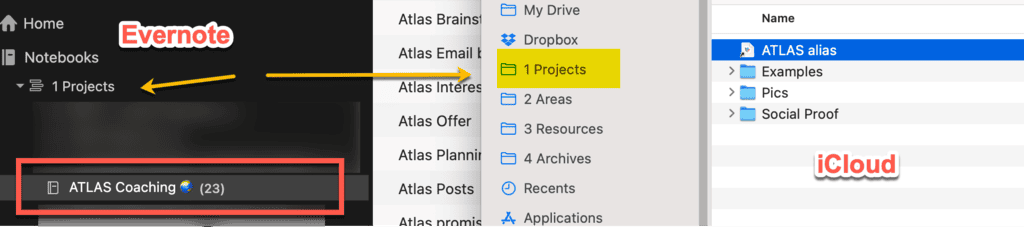
The main area I keep my ideas organized is within the folder structures on my devices.

For that I use Tiago’s PARA system

With the PARA structure, everything is synced across my devices.

But let’s deal with idea organization

The main central location for ALL my ideas is within Evernote. Because I have Evernote on all my devices, I can easily capture thoughts, ideas, pics…whatever.

And, I set up the PARA idea organization structure in Evernote as well.

So, for example, if I have a thought about email marketing I capture it in Evernote and then move it to the “email marketing” notebook.

When I do any outlining for a course or program, I may do that in Evernote, Google Docs, or even a Mindmap.

But the KEY is…the CENTRAL location for me to start looking for the ideas I captured are within Evernote.

Here’s an example

ideas organized

So what does this mean to keep your ideas organized?

It means you no longer need to “choose how” to store, where to organize etc.

As long as you have your ideas organized with a structure (like PARA) duplicated across your devices, you will know where to look.

Let’s look at this idea organization example in practice:

When I look for something I go to Evernote first.
If it’s not in the notebook, I check my iCloud/mac
If it’s not there, then I check google drive

The thing I need is usually in one of those three places. Because they are my main capture sources.

Now.

Let’s say I need to find an email I wrote.

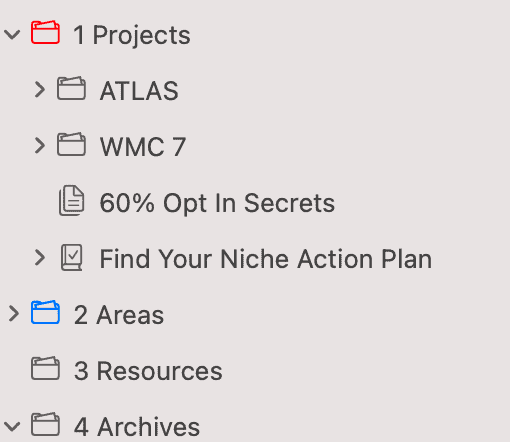
Guess what. My main writing tool Ulysses, has the same PARA structure.

This means I can…

 organize ideas for writing:

organize ideas
Do you see how I organize my ideas on all my devices?

The same projects, folder names etc.

So with this in place, I am free to go wherever I feel comfortable and brainstorm🙂

Knowing where my ideas are organized so I can find and retrieve them later🙂

What about you? Drop me a note below about your idea organization tips 🙂

Read More